
Book Week, the Easter Bunny & Santa: Cultural celebrations and Montessori’s view on fantasy for young children

In this article
Every year, trainers at MECTA receive similar inquiries regarding the role of fantasy in Montessori early childhood education. We emphasise that fantasy is best introduced to children over the age of three. But what does this mean for the cultural celebrations we experience as a nation?
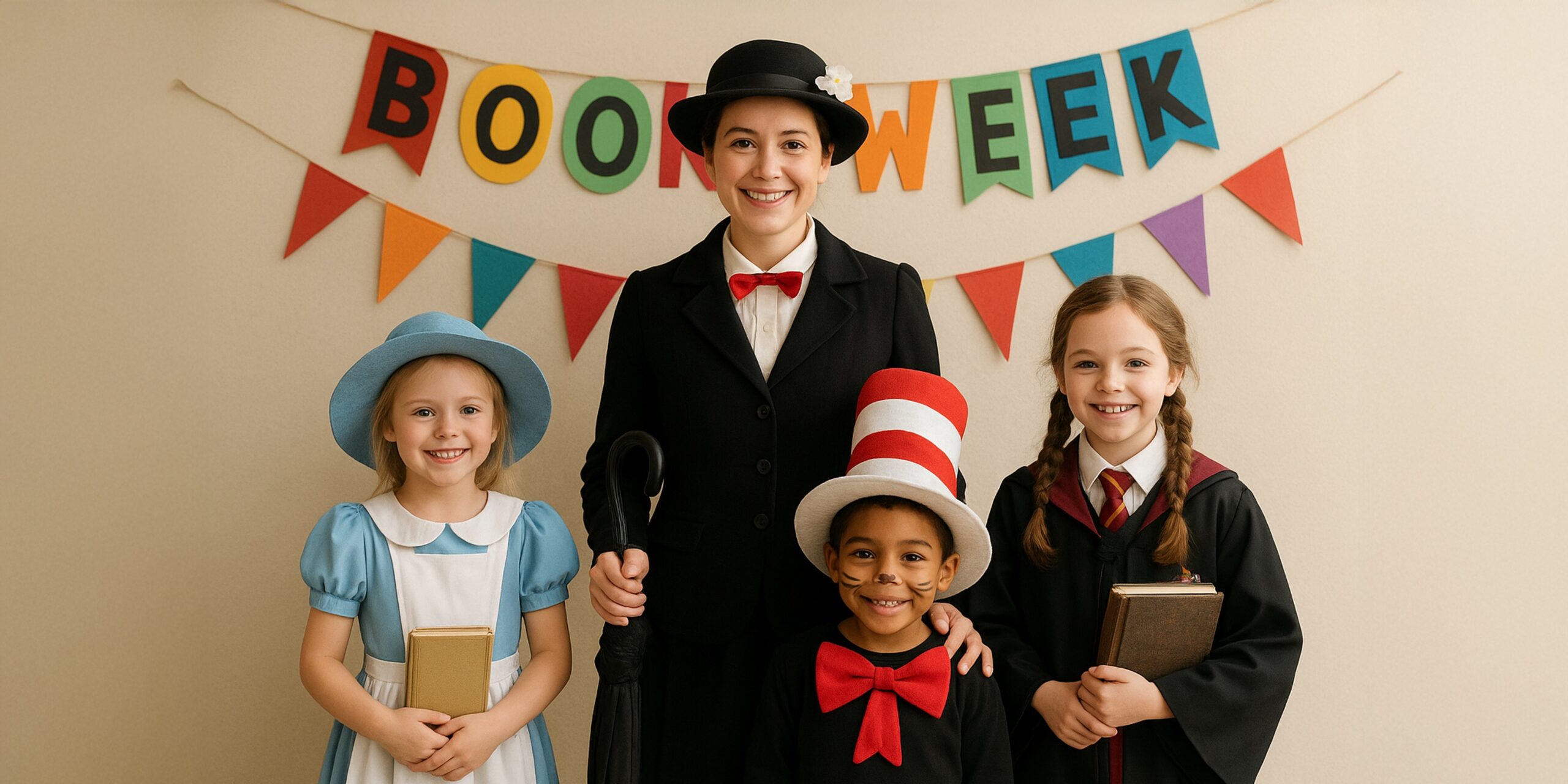
Book Week has quickly become a beloved tradition across schools and early childhood services in Australia. Reflecting on my own classroom experiences, I realise it wasn’t a significant part of our curriculum. However, it seems that over the years, every service and school now embraces this fun and imaginative event.
This brings up important questions:
- How do we approach fantasy books for children under three?
- What role do cultural experiences play in their understanding of fantasy?
Let’s consider a typical scenario: it’s November, and you’re a toddler entering a shopping centre with your parents. What do you see and hear? Who is that bearded man in the red suit? Chances are, you recognise him. From your very first Christmas, you’ve been exposed to this character, who appears everywhere in his thick red suit and big black boots, even in the sweltering heat of an Australian summer.
In some stores, Santa Claus has even been given an Australian twist—sporting a Hawaiian shirt, board shorts, a hat, sunglasses, and thongs. This illustrates how Christmas traditions, such as Santa, have been woven into the fabric of Australian culture. While we may not share the climate of Lapland, we still celebrate alongside the rest of the world.
As we move into April, autumn arrives, and shops brim with Easter eggs, hot cross buns, and giant rabbits wandering through shopping centres handing out chocolate. For a small toddler, these oversized representations of rabbits can be quite intimidating. It begs the question: why do we celebrate springtime traditions in autumn? And why a giant rabbit? Just like Christmas, Australia adopted this European tradition of celebrating the return of spring, even though it is our autumn.
There are religious reasons for the timing of these celebrations, notably the birth of Jesus Christ and his resurrection. However, we largely adopted these traditions during colonisation, bringing them over from Europe as the English settled here. We have adapted them to suit our sunburnt country and celebrate them with our loved ones. These festivities are an integral part of life in Australia, and our children are exposed to them, whether we intend for them to be or not.
As we navigate these cultural celebrations, it’s essential to reflect on how they align with Montessori principles, the developmental stages of young children, and how these traditions resonate within Australian culture.
Understanding Fantasy and Reality in Montessori Education
In Montessori education, the distinction between fantasy and reality is crucial, especially for children under the age of three. Dr Montessori believed that young children are in a sensitive period for developing their understanding of the world around them. A sensitive period refers to a specific time frame in a child’s development when they are particularly receptive to certain types of learning and experiences. During these periods, children exhibit heightened sensitivity and focus on particular skills or concepts, making it easier for them to absorb information and develop new abilities.
It’s during this time that we encourage the child to engage with concrete experiences rather than abstract concepts. This raises important questions about how we navigate cultural celebrations filled with fantasy, such as Book Week, Easter, and Christmas, to name a few.
The Role of Cultural Celebrations
Cultural celebrations are rich with symbolism and stories that can captivate children’s imaginations. However, for children under three, the challenge lies in presenting these celebrations in a way that aligns with their developmental stage. For instance, during Book Week, children are exposed to a plethora of characters and stories that may seem fantastical. It’s essential to balance these experiences with tangible, real-world connections.
Consider the various cultural experiences that young children encounter. When they see Santa Claus in a shopping centre, they are not just seeing a character; they are experiencing a cultural phenomenon that is deeply embedded in Australian society. The sight of Santa, even in a Hawaiian shirt, evokes curiosity and wonder. But how do we help children process these encounters?
Navigating Fantasy in Early Childhood
One effective strategy is to engage children in conversations about characters and the stories they embody. Rather than presenting Santa Claus as an absolute reality, educators and parents can promote imaginative play while helping children differentiate between fantasy and reality. For instance, when discussing Santa, we can highlight the story behind him, focusing on the values of kindness and generosity he represents, rather than merely the fantastical elements.
Incorporating local cultural practices can further enrich this learning experience.
In Australia, we celebrate not only Christmas but also significant cultural events like NAIDOC Week, Lunar New Year, and Diwali, each bringing its own unique stories and traditions. By introducing children to a diverse range of cultural narratives, and embedding these into our curricula year-round, we can cultivate a deeper understanding of the world while being mindful of their developmental stages.
It is also crucial to recognise that not all children’s literature revolves around fantasy. Many books focus on historical figures and non-fiction narratives. In the Infant community, children are exposed to factual stories, including those about animals, the environment, and various ecosystems. Literature encompasses much more than just whimsical tales like Alice in Wonderland or The Gruffalo. Australia is fortunate to have talented authors and illustrators who create stories about our native wildlife, traditions, people, and culture, and showcase the country’s rich and diverse Indigenous art forms for our smallest Australians to enjoy!
Embracing Imagination Responsibly
As we navigate the landscape of fantasy and reality in early childhood education, it’s vital to approach cultural celebrations with intention. By understanding Montessori principles and recognising the developmental stages of young children, we can create enriching experiences that honour both imagination and reality, while protecting the child’s developing understanding of the real world.
Ultimately, the goal is to cultivate a love for stories, reading, and cultural traditions while ensuring that children feel secure in their understanding of the world around them. We can all do our bit as educators, parents or caregivers, to help these young children celebrate the magic of imagination while grounding them in the realities of their amazing cultural heritage.